I have a bit of a bittersweet update. This August, while a huge part of Spain is plunging into a once-in-a-lifetime total darkness, I’ll be 4,000 miles away. I’m heading back to Maryland to spend time with my family—because, apparently, I wouldn’t miss the joy of 90°F heat with 90% humidity on a muggy Chesapeake Bay day for anything. Clearly, my timing is impeccable, and I’m trading a solar corona for a "Shadow Trap" of my own making.
But even from the swampy shores of Maryland, I’m not leaving you hanging. If you’ve been eyeing August 12th for your trip, you’re basically holding a winning lottery ticket, but you need to know how to avoid the "Shadow Trap" on the ground. You see, Spain isn't a flat desert; it’s a landscape of mountains, narrow medieval streets, and 1970s apartment blocks perfectly positioned to block your view right at the peak moment when the sun is low on the horizon.
“We found a rental in a tiny village in Soria. It looks quiet on the website, so we should be fine for the eclipse, right?”
The "Solar Twin" weekend: Let the locals do the legwork
This week in Spain is what experts call the "Solar Twin" window. Because of the earth’s tilt, the sun is sitting in almost the exact same spot now as it will be during the eclipse in August. While you’re likely reading this in the States, thousands of local aficionados and authorities here are currently out in the streets doing "dry runs" to see where the shadows fall.
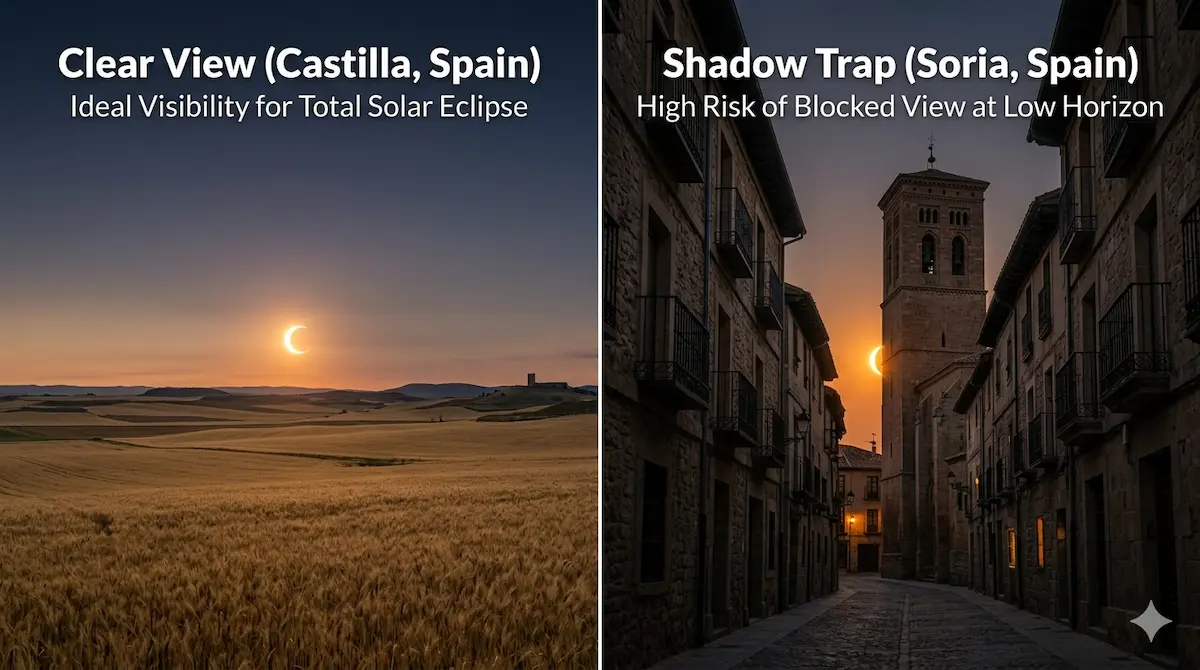
What this means for you: After this weekend, keep your eyes peeled. We’re about to see a flood of tested maps and official reports showing exactly which plazas and hills are "eclipse-safe." I wouldn't even be surprised if some hotels start slapping an "Eclipse-Ready" seal of approval on their listings—knowing how we do things here, it's only a matter of time before it becomes a marketing trend.
The "Golden Hour" Eclipse: Valencia’s Magical (and Risky) Totality
There is one specific image that I suspect will go viral and travel around the world on August 12th: the Mediterranean coast plunging into a deep, eerie indigo while a "Black Sun" hangs just above the horizon. It’s a moment of pure magic, where the Spanish summer heat meets the celestial chill of totality.
But will you see the sea? Absolutely, and in a way that feels almost supernatural. Although the sun will be sitting behind you—setting over the mountains in the West—the Mediterranean will act as a giant, dark mirror. As totality hits, you will see a massive, velvet shadow sweep across the water from the land toward the horizon. The vibrant turquoise of the Mediterranean will vanish, replaced by a metallic, deep violet light that only exists for those few minutes of "Black Sun."
The Technical Warning: Because the sun is at a breathtakingly low angle (just 2° to 4° above the horizon), the "Shadow Trap" is at its most dangerous here. If you are standing on the sand, any beach apartment or even a row of palm trees behind you could block the entire eclipse. To capture that world-class photo, you must ensure your view toward the Inland/West is perfectly flat. If you get it right, the contrast between the dark sea in front of you and the corona behind the city skyline will be the highlight of your life.
Mark my words: on the morning of August 13th, your social media feeds will be flooded with that one impossible shot. You’ll see the Mediterranean looking like a sea of dark mercury under a silver-ringed sun, a photo that will likely travel around the world as the definitive image of the 2026 eclipse. If you scout your location now and stay clear of the Shadow Trap, you won’t just be double-tapping that photo—you’ll be the one who lived it.
Don't settle for "almost"
I’ve seen people plan trips for years only to have a single tree ruin the view. Since I won’t be here to physically walk you to the best rooftop, I want to make sure you use the info coming out this week to lock in your location.
The next time a total eclipse hits these same provinces won't be until the year 2180. Standing under a "Black Sun" is something you'll tell your grandkids about. So, once the "Solar Twin" reports are in, let's make sure you're standing in the light (until it vanishes), and prepare for the most beautiful, sweat-soaked day of your life.
Eclipse Quick Tips
Where is the best visibility?
Galicia, Castilla y León, and Valencia are the sweet spots. Madrid is right on the edge; for the real deal, you'll want to head about an hour north towards Segovia or Burgos to be safely inside the path of totality. In Valencia, remember the sun will be extremely low (2-4°), so a clear western horizon is mandatory.
What about the crowds and travel?
It’s going to be intense. August 15th is a major national holiday, but it’s also the "cambio de quincena"—the massive mid-month shift when half of Spain ends their vacation and the other half starts. Roads, airports, and RENFE trains will be at absolute capacity. If you aren't already where you need to be by the 11th, you’re going to have a stressful time.
Can I just use my sunglasses?
Absolutely not. The Spanish summer sun is fierce, and even at 99% coverage, it can cause permanent eye damage. You need ISO-certified eclipse glasses. I’m already seeing cheap knock-offs popping up online, so buy yours from a reputable science or astronomy source well in advance.
Heading to Spain for the eclipse?
Let’s check your itinerary before I fly to Maryland.